Designing aHematopathologyReporting Platform
Where AI organizes evidence. Humans decide.
The Challenge
In AI-assisted pathology, the main risk is not AI accuracy. Once a pathologist clicks Sign, the responsibility is theirsclinically and professionally. The real challenge was: How do we help pathologists complete reviews faster while remaining fully confident in their decisions? The reporting experience had to support high-frequency daily use, repetitive review workflows, visual validation under time pressure, and strong muscle memory with minimal cognitive load.
Goals
Support Confident Human Judgment
Design the system to support confident human judgment through a repeatable, low-friction workflow optimized for daily expert use. AI organizes evidence. Humans decide.
Optimize for Repetition
Speed does not come from shortcutsit comes from habit and predictability. Design for pathologists who review many reports every day.
Enable Fast Validation
Not every report requires deep inspection. Time spent validating should be minimal. Confidence at sign-off matters more than feature richness.
Process
Understanding the Workflow
Studied pathologist workflows and constraints. Pathologists review many reports every day. Speed comes from habit and predictability, not shortcuts. Key realities: Not every report requires deep inspection, detailed tabs are entered only when needed, time spent validating should be minimal, and confidence at sign-off matters more than feature richness.
Designing the Decision Loop
Instead of thinking in pages, the experience was designed around a repeatable loop: Report List → Summary → Detailed Tabs → Exit & Return → Sign-off. Every design decision reinforces this loop.
Report List Responsibility & Prioritization
The report list is the entry point of confidence. It helps pathologists quickly understand which reports are assigned to them, what is ready for review, and what requires action or follow-up. The goal is clarity and prioritization, not exploration.
Summary Orientation, Not Diagnosis
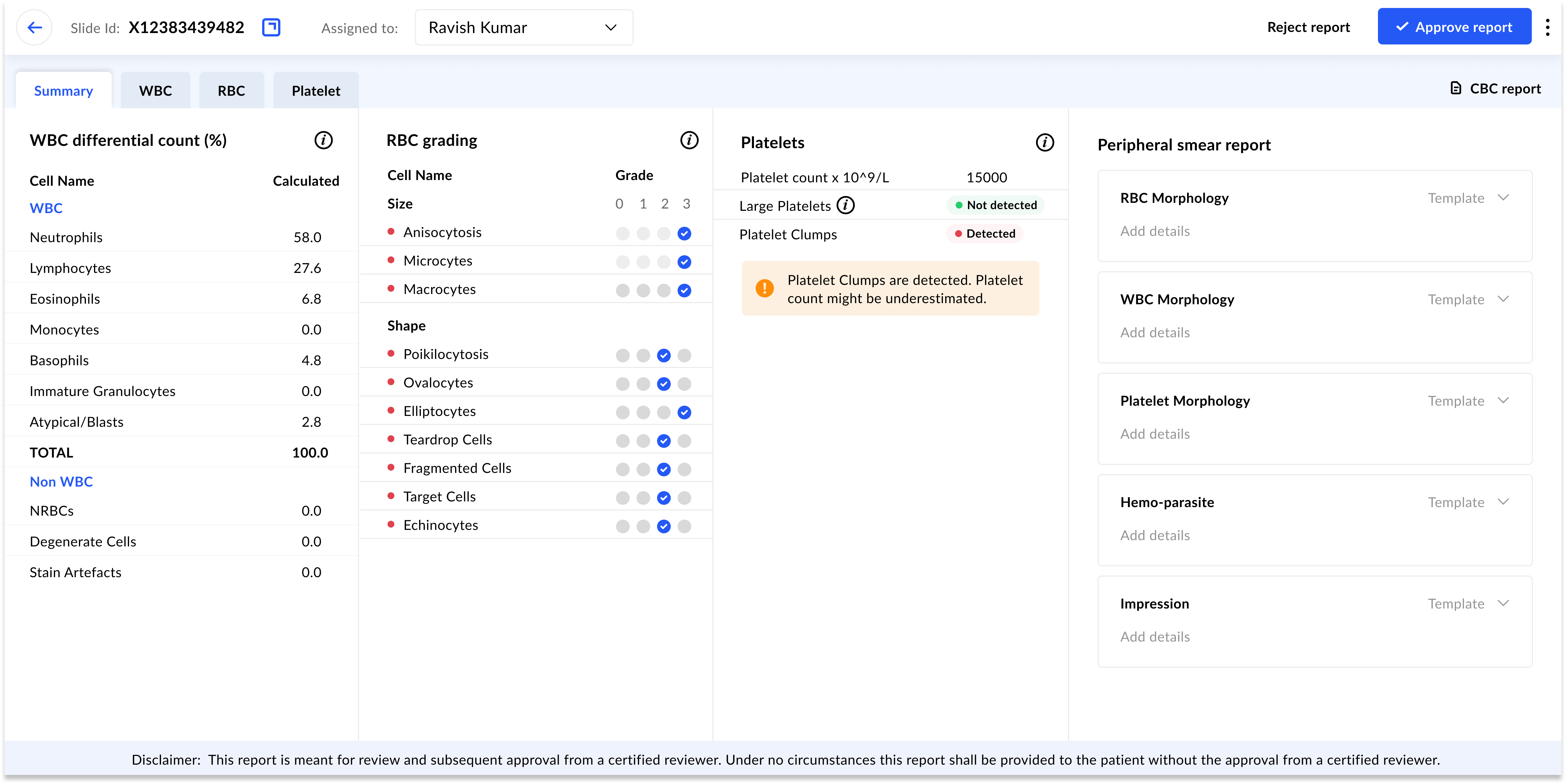
The Summary screen answers: What kind of case is this? Is anything abnormal or critical? It provides high-level WBC, RBC, and Platelet signals with clear abnormality indicators. What it intentionally avoids: raw cell images, exhaustive cell lists, and final interpretations. The Summary prepares the pathologistit never replaces review.
Detailed Tabs Selective Validation Spaces
Pathologists enter WBC, RBC, or Platelet tabs only when triggered by abnormal findings, CBC context, or data quality issues. Inside each tab: Left shows values, counts, and flags; Right shows visual evidence via grid, split, and microscopy views. This enables fast validation: Do these images support these numbers?
Design System Governance
Created and governed a custom design system supported by shared Figma components. The system standardized layout anatomy, typography and hierarchy, status and abnormality indicators, and core interaction patterns to maintain consistency as the product evolved.
Key Features
Image Controls
Pathologists can adjust brightness, contrast, hue, saturation, and cell sizematching real microscope behavior and revealing subtle morphology differences.
Reclassification
AI suggestions are easy to correct using low-friction interactions such as multi-select and drag-and-drop. Correcting AI errors is intentionally easier than ignoring them, demonstrating human authority over AI.
Cell-Level Comments
Comments can be added directly to individual cell images to support collaboration and preserve diagnostic reasoning in complex cases, showing evidence-linked reasoning.
Consistent Layout & Muscle Memory
Layout structure is consistent across screens, interactions behave the same everywhere, visual signals retain the same meaning, and terminology never changes unexpectedly. Even with training, consistency ensures the workflow never needs to be re-learned.
Deliberate Sign-off Confirmation
Signing a report is a deliberate act, not a quick click. The confirmation step encourages a brief mental check, reinforces responsibility, and closes the review loop with confidence.
Impact
Key Learnings
This project shifted my focus from improving AI output to designing safer decision environments for experts.
We didn't redesign pathology. We redesigned how confident decisions are madeagain and again, every day.
Pathologists focused on cases, not the interfacethe ultimate signal of success.
Speed in expert workflows comes from habit and predictability, not shortcuts or feature richness.